A cat corner does not have to be a whole room. It can be a familiar spot that brings a few daily activities together: somewhere to rest, a surface to scratch and a place to watch what is happening. Planning those uses before choosing furniture makes a small space easier to work with.
Think about the base, not only the height
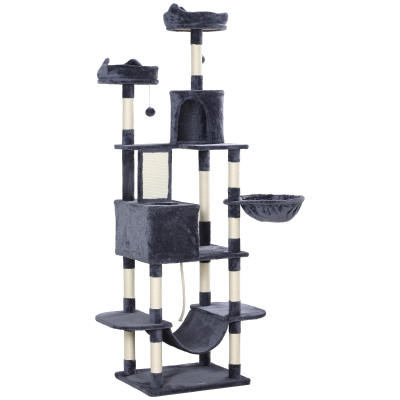
A tall cat tree can look compact in a photograph. Check the dimensions of its base, the reach of its platforms and the clearance around it. Keep doors and walking routes usable, and follow the model’s installation and anti-tip instructions. Height alone does not tell you how much of the room a piece will occupy.
Choose resting surfaces that suit the cat
Look separately at the size of a bed, hammock or condo opening. Compare those dimensions with your cat’s usual sleeping position and the stated capacity of each relevant part. A single overall load figure may not describe the limits of every platform.
Access matters too. Look at the route between levels and the space available for getting on and off. If a particular model does not list enough information to judge that route, ask about the missing dimensions.
Consider the wall as a separate installation project
Wall furniture can free floor space, but it introduces a different set of checks. Confirm that the wall construction and fixings are appropriate, follow the supplied mounting instructions, and leave a usable route between components. Do not treat the included hardware as suitable for every wall.
Make upkeep part of the layout
Choose a position where you can reach fabric surfaces, inspect fixings and clean around the base. Check which parts can be removed and which cleaning methods are actually specified. A layout that is easy to maintain is easier to keep inviting.
Explore cat trees and towers or compare wall-mounted cat furniture. Start with your cat’s routine and the measurements of the space, then choose the furniture around them.